
Stop at hard resistance
If the handle will not budge with firm hand pressure, stop. Do not reach for pliers or a wrench for leverage. A stem that snaps under a seized nut leaves you with an open line you cannot close.

Leaking Shut-Off Valve
A leaking shut-off valve under your sink or toilet in an older east metro home usually means the supply stop is seizing or weeping. Where to safely gate the DIY, and when to book a quarter-turn supply stop replacement with Twin City Pipeworks.
Prefer to call or text? 651-247-4495
About Twin City Pipeworks
A leaking shut-off valve under your sink is almost always the supply stop giving up, not the pipe behind it, and in older east metro homes it usually starts the moment you try to close it. Twin City Pipeworks is a licensed, insured MN plumbing shop working the east metro and St. Croix Valley within about 30 minutes of Lake Elmo, and the fix we do most often here is a quarter-turn supply stop replacement with upfront per-task pricing so you know the number before any work starts. The clean path is to book a supply-stop repair online, and every job carries a 1-year warranty on all work.
Here is the part that trips people up. That little valve, called a supply stop or angle stop, has an internal rubber washer and a packing nut around the stem. On the original multi-turn stops in a lot of pre-1990s Stillwater, Oakdale, and Oak Park Heights homes, both of those dry out and mineralize after 20 or 30 years of sitting untouched. So the valve does not fail while it is open. It fails the first time you crank it to shut the water off, which is usually the worst possible moment.
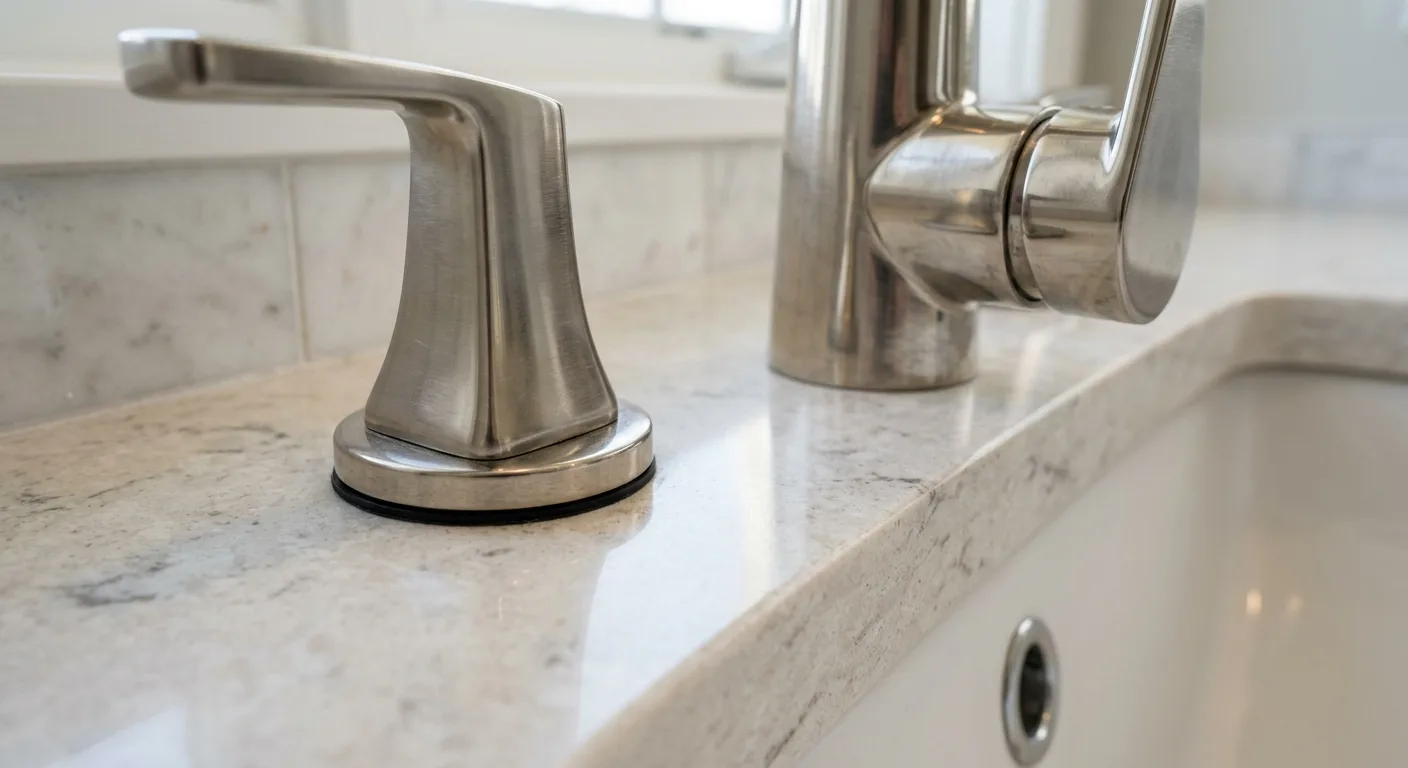
A supply stop leaks in one of three spots, and which one it is tells you how urgent this is. The most common is a weep from the packing nut, the hex nut around the moving stem, which loosens as the old packing dries out. Next is a drip at the compression joint where the valve grips the copper or the wall stub-out. Last, and least common, is the valve body itself cracking. Look with a dry paper towel and find the exact wet spot before you touch anything.
If the leak is a slow weep you can catch in a bowl and the valve still holds pressure, you have a little time. If it is a steady drip or an active spray, get a container under it, keep the cabinet dry, and get it on the schedule. Not sure whether the water is coming from the stop or from the fixture above it? Our leak detection and repair service pins down the source before anyone starts cutting.
Why Twin City Pipeworks
If the handle will not budge with firm hand pressure, stop. Do not reach for pliers or a wrench for leverage. A stem that snaps under a seized nut leaves you with an open line you cannot close.
A multi-turn stop that spins freely but never stops the water has a worn or dislodged washer inside. The valve is done. It needs replacing, not tightening.
If water beads at the stem nut when you turn it, the packing has dried out. Snugging the nut a quarter turn sometimes buys time, but on old valves it just as often starts a worse leak. Know when to stop.
If the stop will not close and you need the water off, shut your main instead. It is usually on the basement wall facing the street near the meter. That isolates the whole house until the stop is replaced.
There is a clean line between a DIY tighten and a job worth booking, and it is the point of risk, not the point of annoyance.
On a Woodbury bathroom vanity last winter, the homeowner had snugged a weeping packing nut just enough to hold, then the stem let go when the water heater backfed pressure. We replaced both stops with quarter-turn valves and the fixture in one visit. The old multi-turn stop was never going to survive being touched again.

Here is the honest part a lot of shops will not say. If your supply stop is a modern quarter-turn valve, it is only weeping slightly at the compression nut, and a careful eighth-turn with a wrench stops it clean and dry, you may be done. Watch it for a day. Do not pay for a valve swap you do not need. But the older the valve, the less true that is, and forcing a seized multi-turn stop is the fastest way to turn a dry cabinet into a wet floor. When it is time, book a supply-stop repair online and you will get the number before any work starts.
Why Twin City Pipeworks
A multi-turn stop uses a rubber washer pressed down by a threaded stem, plus stem packing. Both are wear parts. They dry out and mineralize over decades of sitting still, which is exactly why the original valve failed the first time you moved it.
A quarter-turn stop uses a ceramic or coated ball that rotates 90 degrees. No washer to compress, no packing to dry out. It closes fully in a single quick motion and is far more reliable after years of sitting untouched.
A quarter-turn is on or off in one move, so when a supply line lets go you shut it fast. No counting turns, no wondering if it is all the way closed while water runs.
In the older east metro housing stock we service, valves get moved once a decade at most. A quarter-turn tolerates that neglect where a multi-turn washer valve does not. It is the upgrade that stops this from happening again.
Replacing a supply stop is a contained repair when it is done right, and knowing the steps tells you what to expect on the visit.
Curious what a common repair runs before you book? Get an instant quote on common repair tasks, or go straight to booking a supply-stop repair online.
Book your repair
A weeping or seized supply stop under your sink or toilet is a small repair when it is caught early and a wet cabinet when it is not. Book online with Twin City Pipeworks for supply-stop replacement across the east metro and St. Croix Valley, within about 30 minutes of Lake Elmo. Upfront per-task pricing, fully insured, 1-year warranty on all work. Want a number first? Get an instant quote on common repairs. Prefer to reach a person? Call or text (651) 247-4495.
Prefer to call or text? 651-247-4495
Two easy ways to get started
Keep Exploring
Jump straight to the service or info you need, or book your repair online any time.
Twin City Pipeworks
Honest, upfront pricing and a 1-year warranty on every job. Book your visit online, or get an instant quote on a common repair.
Prefer to call or text? 651-247-4495
Good to Know
From online booking to finished job, simple and transparent every step of the way.
Pick a visit time online, or get an instant quote on a common repair. No phone tag.
We assess your job and give you clear, honest pricing before any work begins. No surprises.
A licensed plumber shows up on time, does the job right, and cleans up when finished.
We walk through the finished work with you, backed by our 1-year warranty on all work.
Ready to get your plumbing fixed?
Book online in under a minute. Prefer to call or text? 651-247-4495.